


Week Zero offered only five games involving Power Four teams, but the small schedule still created a useful hierarchy of evidence.
North Carolina produced the most consequential result against a TCU team with the stronger 2025 efficiency profile. Virginia supplied the cleanest performance in the weekend’s only Power Four conference game. No. 14 USC looked like the best team for three quarters, while Florida State and Stanford won without fully resolving last season’s questions.
Here is what mattered most, ordered by the value of the result and the strength of the underlying performance.
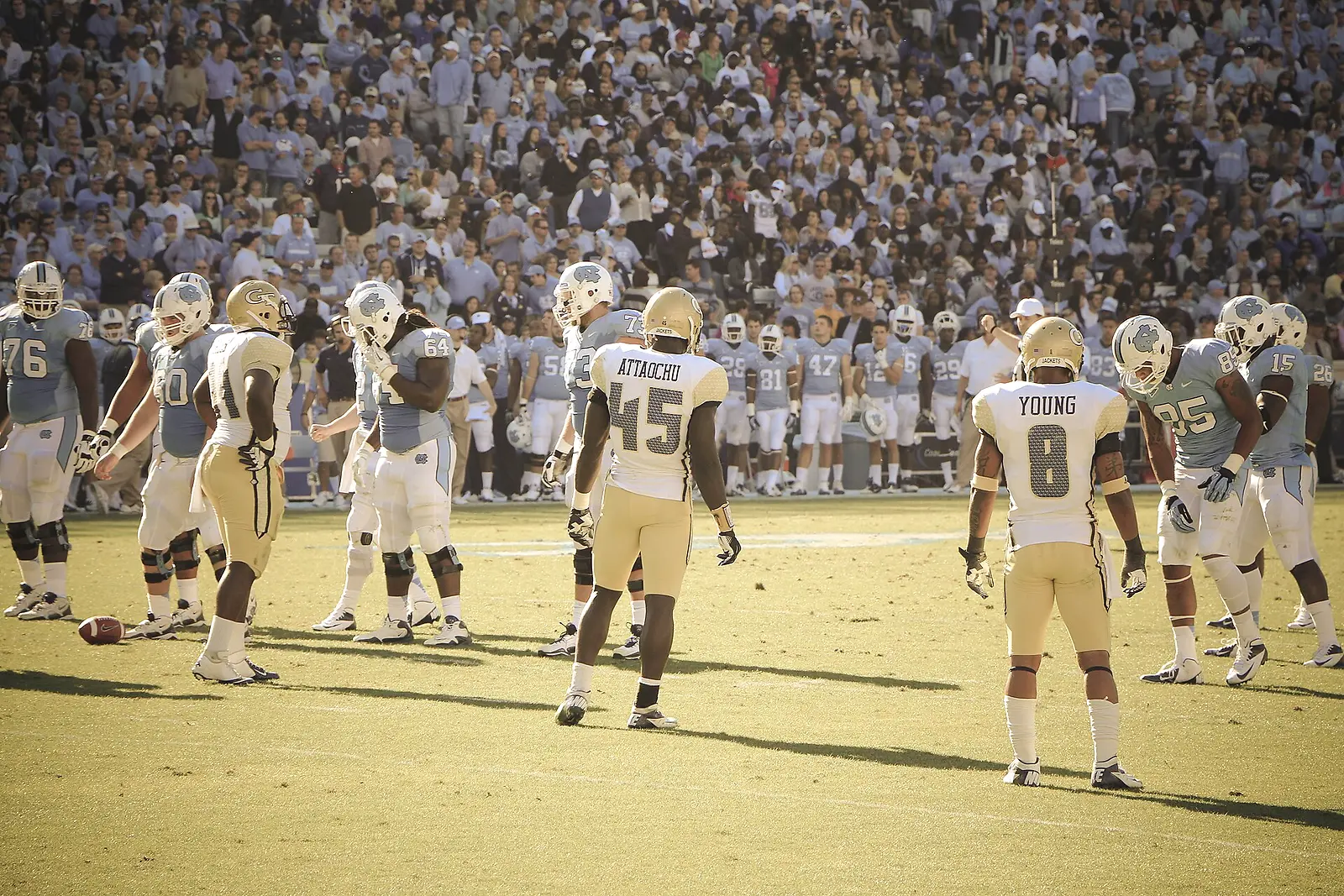
North Carolina 15, TCU 10: The upset was built on defense, not luck
North Carolina’s first victory under Bill Belichick last season did not arrive until Week 3. His second team started with a result that required a much larger correction. TCU finished 2025 ranked 54th in StatTake’s overall EPA margin and 35th after opponent adjustment; UNC ranked 119th and 106th. The Tar Heels still held the Horned Frogs scoreless for the final 49 minutes and won 15-10.
The margin came from high-leverage defense. UNC stopped TCU on downs three times, recovered a fumble and ended the Horned Frogs’ streak of 30 consecutive nonconference regular-season games with at least 28 points. Xavier Lewis produced seven tackles, 4.5 tackles for loss and two sacks. TCU’s Jeremy Payne gained 142 yards on 25 carries, but the Horned Frogs finished with only 281 total yards and 17 first downs. Billy Edwards Jr. added 232 passing yards, and Jelani Thurman turned four catches into 94. The official North Carolina recap and box score show a team that did not dominate possession; it dominated the snaps that ended drives.
Virginia 34, NC State 8: The weekend’s most complete Power Four statement
Virginia removed almost every source of suspense from the only conference game on the slate. The Cavaliers led 17-0 at halftime, outgained NC State 413-168 and held the ball for more than 38 minutes before a sellout crowd of 62,779. Beau Pribula completed 9 of 11 passes for 155 yards and two touchdowns, then ran 15 times for 110 yards. He became Virginia’s first 100-yard rushing quarterback since Brennan Armstrong in 2022, according to the school’s official game report.
That adds a new solution to a team whose 2025 résumé was stronger than its offensive profile. Virginia won 11 games but ranked 56th nationally in offensive EPA per touch; its defense ranked 22nd in EPA allowed. NC State quarterback CJ Bailey, who threw for 3,105 yards and 25 touchdowns in 2025, finished 12-of-23 for 84 yards—his first sub-100-yard game in 23 career starts. The Wolfpack managed 10 first downs and 3.3 yards per play. Virginia’s 3-for-14 third-down rate is the warning, but four fourth-down conversions and 258 rushing yards kept the offense on schedule.
No. 14 USC 42, San José State 26: Elite offense, incomplete defensive verdict
The only ranked Power Four team in action looked the part until the fourth quarter. USC led 35-3 after three periods, gained 505 yards at 6.6 per play and converted 9 of 13 third downs. Jayden Maiava was 25-of-29 while building that lead, finishing with 286 passing yards, two passing touchdowns and another score on the ground. Trent Mosley caught seven passes for 118 yards and a touchdown, with 52 yards after the catch, as six of USC’s 10 pass catchers made their Trojan debuts.
That production supports the repeatable part of USC’s 2025 profile: the Trojans ranked seventh nationally in offensive EPA per touch, fifth in points per drive and 14th in overall EPA margin. The unresolved part remains a defense that ranked 60th in EPA allowed. San José State scored 23 fourth-quarter points, many against USC reserves, turning a 32-point margin into a 42-26 final. The official box score still shows a 37:15 possession total and a 29-19 first-down edge for USC. The offense is playoff-caliber; the defensive case remains open.
Florida State 34, New Mexico State 17: The box score still contains last year’s problem
Florida State gained 419 yards, rushed for 217 and went 6-for-6 in the red zone. Ousmane Kromah delivered the largest individual signal with a career-high 115 yards on 14 carries, including a 52-yard run. Ashton Daniels completed 17 of 27 passes for 202 yards with one touchdown and one interception, and the Seminoles held New Mexico State to 47 rushing yards.
The concern is how often an overmatched opponent stayed on the field. New Mexico State converted 10 of 17 third downs and passed for 272 yards. That resembles the imbalance that undermined Florida State’s 2025 season: the Seminoles ranked sixth nationally at 472.1 yards per game and 23rd in offensive EPA per touch, yet went 5-7 while finishing 71st in defensive EPA allowed. The official box score makes the next test—an ACC opener against No. 19 SMU—much more informative.
Stanford 37, Hawai‘i 27: A new staff passed the first crisis test
Stanford’s opener under Tavita Pritchard turned from comfortable to chaotic. The Cardinal led 23-7, allowed three fourth-quarter touchdowns and trailed 27-23 before Davis Warren completed all five of his passes on a 58-yard go-ahead drive. Micah Ford scored his third rushing touchdown with 1:41 remaining, and Tevarua Tafiti returned a Micah Alejado fumble 31 yards to finish the game.
Warren’s line—22-of-34 for a career-high 310 yards, one touchdown and no turnovers—matters for an offense that ranked 121st in StatTake’s 2025 EPA ratings. Stanford did not prevent the crisis, but it found explosive passes of 57 and 48 yards, protected the ball and executed the highest-pressure possession of the night. The official Stanford recap does not prove the Cardinal have solved their Power Four depth problem. It does show that the new staff has a quarterback capable of rescuing a broken game script.
The weekend verdict
North Carolina changed its trajectory most. Virginia produced the best team performance. USC displayed the highest ceiling. Florida State won while preserving a familiar concern, and Stanford showed composure before it showed consistency.
Week Zero’s sample is too small for new national rankings, but large enough to update what each team must prove next. Virginia added quarterback-run efficiency to a defense that already traveled. North Carolina created drive-ending plays after a year without a stable identity. Those are the two results worth carrying forward.
A turnover-neutral view of team quality built from the components most likely to persist.
SUSTAINABILITYPENDINGV1.0-provisionalThe ability to create first downs and points without depending on a single explosive play.
EFFICIENCYPENDINGV1.0-provisionalDown-to-down performance with less credit for isolated, high-variance plays.
WHAT’S YOUR TAKE?
Keep it about the game.
YOUR TAKE BELONGS IN THE CONVERSATION.
Create a free StatTake account to comment beneath full articles. Sign in with a private code sent to your email—no extra password.
- Comment beneath every full article
- Choose one public username
- Keep your email private
Loading comments…