
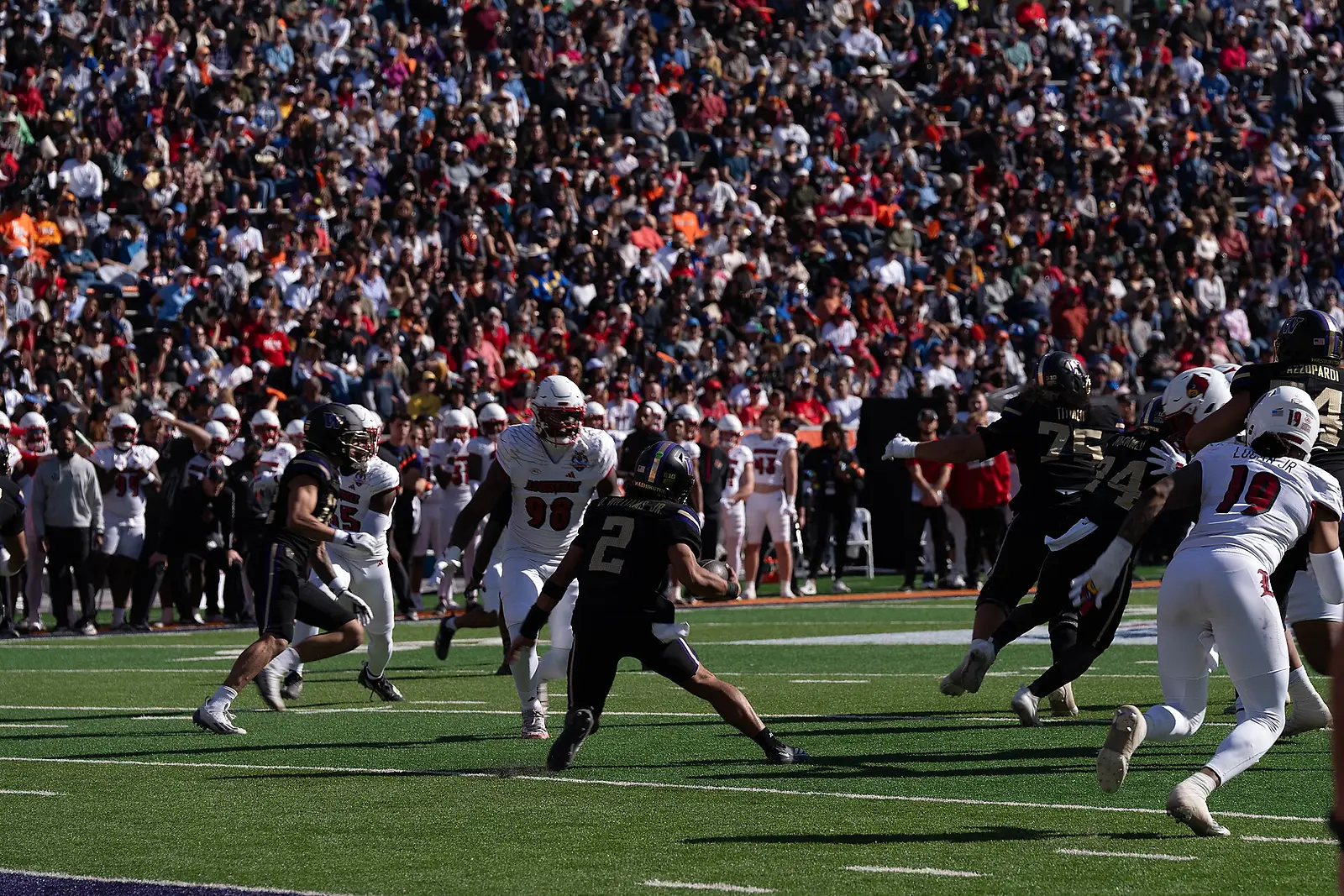
Washington's 24-10 Apple Cup win cost the Huskies the top two running backs on their depth chart.
Quaid Carr will have surgery on an injured hand, and Jayden Limar is out with an elbow injury. Coach Jedd Fisch said both will miss an extended period, though the program does not yet know whether either injury is season-ending, according to Reuters' September 8 report.
The immediate question is who replaces 17 carries. The more important one is how Washington avoids making quarterback Demond Williams Jr. replace all of them.
Seventy-five yards disappear from the rotation
Limar led Washington's running backs with 12 carries for 47 yards and a touchdown against Washington State. Carr, the starter, gained 28 yards on five attempts before his injury. Together they produced 75 yards at 4.4 per carry—not a dominant output, but enough volume to keep the offense balanced.
Williams actually led the Huskies with 61 rushing yards and scored a touchdown. He also threw for 268 yards in the official 24-10 win. His dual-threat ability gives Fisch an obvious short-term answer. It also creates the wrong long-term incentive.
Every designed quarterback run used to replace a missing back exposes Washington's most valuable offensive player to another hit. Williams should remain part of the rushing plan because that stress defines the offense. He should not become its high-volume backfield solution.
Cooley and Bonner have to make ordinary downs work
Trey Cooley and freshman Brian Bonner move to the front of the running-back room. Cooley logged four carries in the opener; Bonner now faces a faster transition from prospect to rotation player than Washington intended.
Their job is not to recreate every explosive possibility Carr and Limar offered. Washington needs reliable protection, correct reads and enough early-down efficiency to keep Williams out of predictable passing situations. The Apple Cup offense did not pull away until two fourth-quarter touchdown drives. Asking a reshuffled backfield to operate cleanly matters more than chasing an immediate 100-yard individual performance.
The defense bought the offense patience against Washington State by forcing three takeaways and holding the Cougars to 0-for-11 on third down. That formula is useful, but takeaway dependence is volatile. The offense eventually must sustain drives without needing the quarterback to lead both the passing and rushing columns.
The schedule offers a short runway
Washington hosts Utah State on September 12 and Eastern Washington on September 19 before Minnesota visits on September 26. The official schedule then sends the Huskies to USC on October 3.
That creates three weeks to identify a workable rotation before the Big Ten schedule demands more. The first two games should give Cooley and Bonner meaningful carries. Minnesota is the rehearsal. USC is where a one-dimensional offense becomes much easier to attack.
Washington still has the best runner on its roster in Williams. The season will be healthier if the Huskies do not have to prove it every week.
How much an offense relies on explosive plays rather than sustainable down-to-down production.
EFFICIENCYPENDINGV1.0-provisionalDown-to-down performance with less credit for isolated, high-variance plays.
SUSTAINABILITYPENDINGV1.0-provisionalThe ability to create first downs and points without depending on a single explosive play.
WHAT’S YOUR TAKE?
Keep it about the game.
YOUR TAKE BELONGS IN THE CONVERSATION.
Create a free StatTake account to comment beneath full articles. Sign in with a private code sent to your email—no extra password.
- Comment beneath every full article
- Choose one public username
- Keep your email private
Loading comments…