


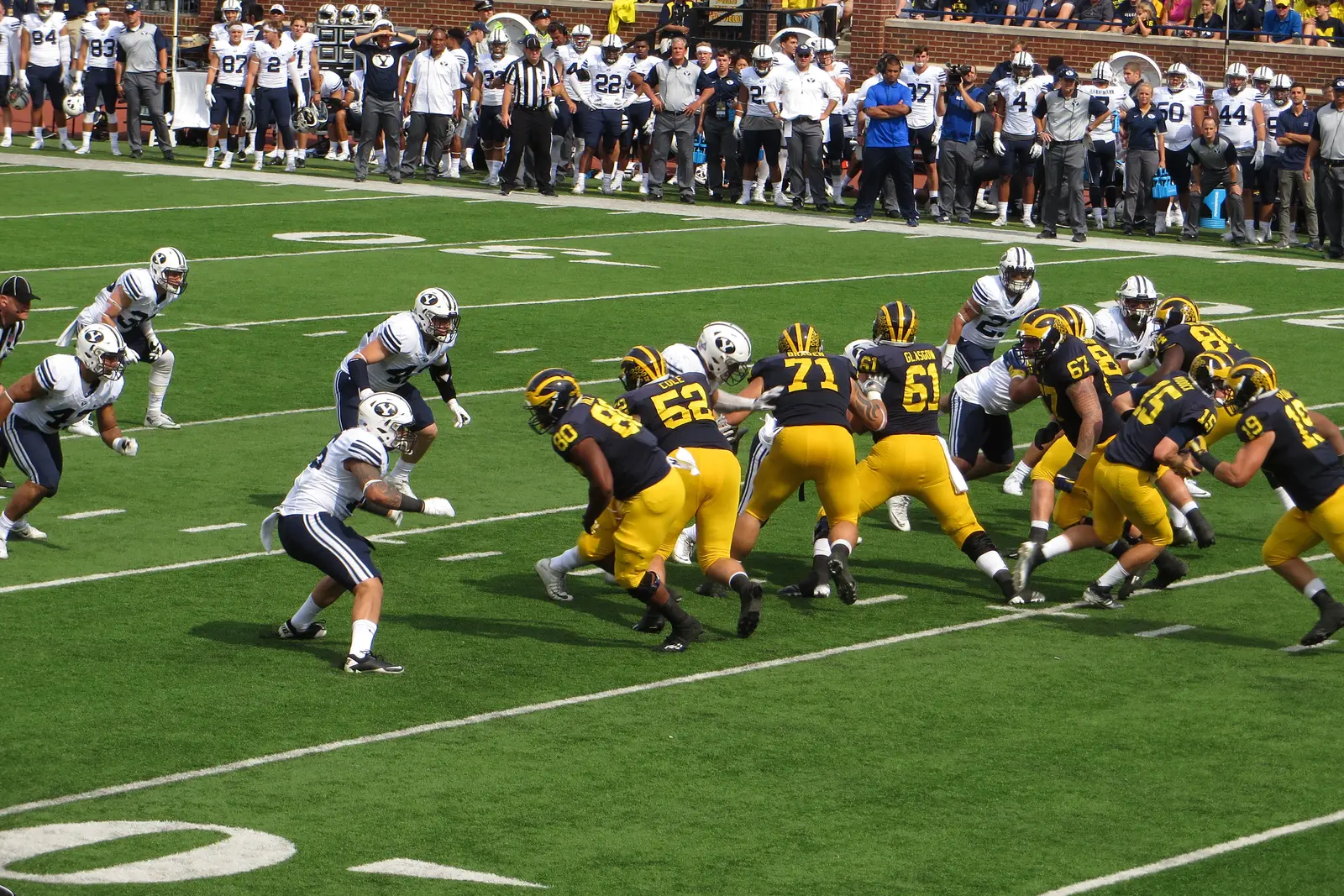
Preseason offensive-line analysis usually begins with a count: how many starters are back? It is useful, but incomplete. Five returning starters can still produce an average line if roles change, injuries interrupt practice or the group never learns to handle pressure together. A less experienced unit can improve quickly when its center, quarterback and tackles communicate well and the scheme limits exposure.
Continuity matters because offensive-line play is collective. A receiver can win an isolated route. A pass rusher can beat one blocker. An offensive lineman can execute his assignment and still watch the play fail because the player next to him saw the front differently.
For contenders, that collective speed often separates an offense that looks talented from one that survives November.
Starts are the beginning, not the answer
Returning starts measure exposure. They tell us who has seen a third-and-long crowd, a late safety rotation and an opponent changing its pressure plan after halftime. They do not tell us whether those starts occurred at the same position, alongside the same teammates or within the same protection system.
The better continuity questions are more specific. Is the center returning? Are both tackles playing the same side? Has the quarterback worked with the same interior trio? Does the line have a sixth player capable of entering without forcing two other position changes?
Texas offers a useful example. The official roster lists Cole Hutson as a fifth-year offensive lineman after he rejoined the program. His individual bio credits him with 48 appearances and 23 starts, including work at multiple interior positions. That flexibility adds more than one experienced name. It gives Texas an answer if the best five requires a change at center or guard.
The center-quarterback relationship
Protection begins before the snap. The center and quarterback must identify the front, account for possible rushers and understand which defender the ball will make wrong. When that relationship is new, even a correct call can arrive late.
This is why center continuity deserves more weight than a simple returning-starter total. The center communicates with both guards, feels defensive tackles stemming before the snap and often has the best angle to recognize an interior pressure. A veteran quarterback can compensate for a young center, and a veteran center can stabilize a young quarterback. Returning both gives an offense a chance to operate faster.
Ohio State enters 2026 with a veteran quarterback and an experienced offensive line. Julian Sayin’s official bio notes that he threw for 3,610 yards and 32 touchdowns in 2025. The Buckeyes do not need protection merely to keep him upright. They need it to preserve the timing and accuracy that made his first season so efficient.
When the line communicates cleanly, Sayin can throw on rhythm. When it does not, a statistically harmless pressure can still erase the exact advantage the offense is built around.
Continuity raises the floor on bad downs
Great offenses will face third-and-8. They will get caught behind the chains by a penalty, a dropped pass or a run blitz. The best lines do not prevent every bad down; they stop one bad down from becoming a disastrous possession.
Experienced groups are more likely to pass off twists, recognize simulated pressure and give the quarterback a usable escape lane. Those plays rarely become highlights. Their value appears in the absence of sacks, fumbles and hurried throws into coverage.
Georgia’s returning linemen provide a strong baseline. Drew Bobo’s official 2026 bio says he started 11 games in 2025 for an offense that averaged 182.1 rushing yards per game and allowed 18 sacks. Those totals do not prove the line was dominant on every snap, but they describe a unit that kept the offense functional across a full schedule.
The ceiling question for Georgia is whether experience turns functional protection into control. A contender does not need five future first-round picks. It needs a line that can create the same picture for the quarterback repeatedly enough that the skill talent plays fast.
The hidden benefit is practice quality
Continuity also changes how an offense spends August. A rebuilt line must teach terminology, test combinations and devote repetitions to basic communication. A returning group can spend more of camp on opponent-specific pressures, changeups and the difficult calls that appear only a few times per game.
Kirby Smart described offensive line as a developmental position that needs extra coaching eyes during Georgia’s spring-practice preview. That development does not stop when a player becomes a starter. Continuity increases the level of the problems a group can practice solving.
This is where depth becomes part of continuity rather than its opposite. A sixth lineman who has practiced at two spots can preserve communication after an injury. Without that player, one absence may force a new center, a new guard and a new tackle alignment all at once.
What StatTake will measure
Raw sacks allowed are not enough. Some quarterbacks create sacks by holding the ball, while some systems protect the line with quick throws. To understand whether continuity is working, the useful measures include pressure rate on standard downs, tackles for loss allowed, short-yardage success and the frequency with which one pressure creates a second mistake.
We will also watch whether a line improves as games progress. Veteran groups should identify how an opponent is attacking protections and reduce free rushers after halftime. If the same pressure works repeatedly, returning starts are not becoming functional continuity.
The best offensive lines make the rest of the roster easier to evaluate. They give quarterbacks a stable platform, let coaches call the full playbook and allow running backs to reach the decision point before contact. That is why continuity changes a contender’s ceiling. It does not guarantee dominance. It increases the number of snaps on which talent elsewhere can matter.
How effectively a program improves, retains and converts players relative to their starting expectations.
COACHINGPENDINGV1.0-provisionalDecision quality and situational execution separated from baseline roster strength.
TALENT ROIPENDINGV1.0-provisionalProduction above or below the output expected from roster talent, experience and returning production.
WHAT’S YOUR TAKE?
Keep it about the game.
YOUR TAKE BELONGS IN THE CONVERSATION.
Create a free StatTake account to comment beneath full articles. Sign in with a private code sent to your email—no extra password.
- Comment beneath every full article
- Choose one public username
- Keep your email private
Loading comments…