
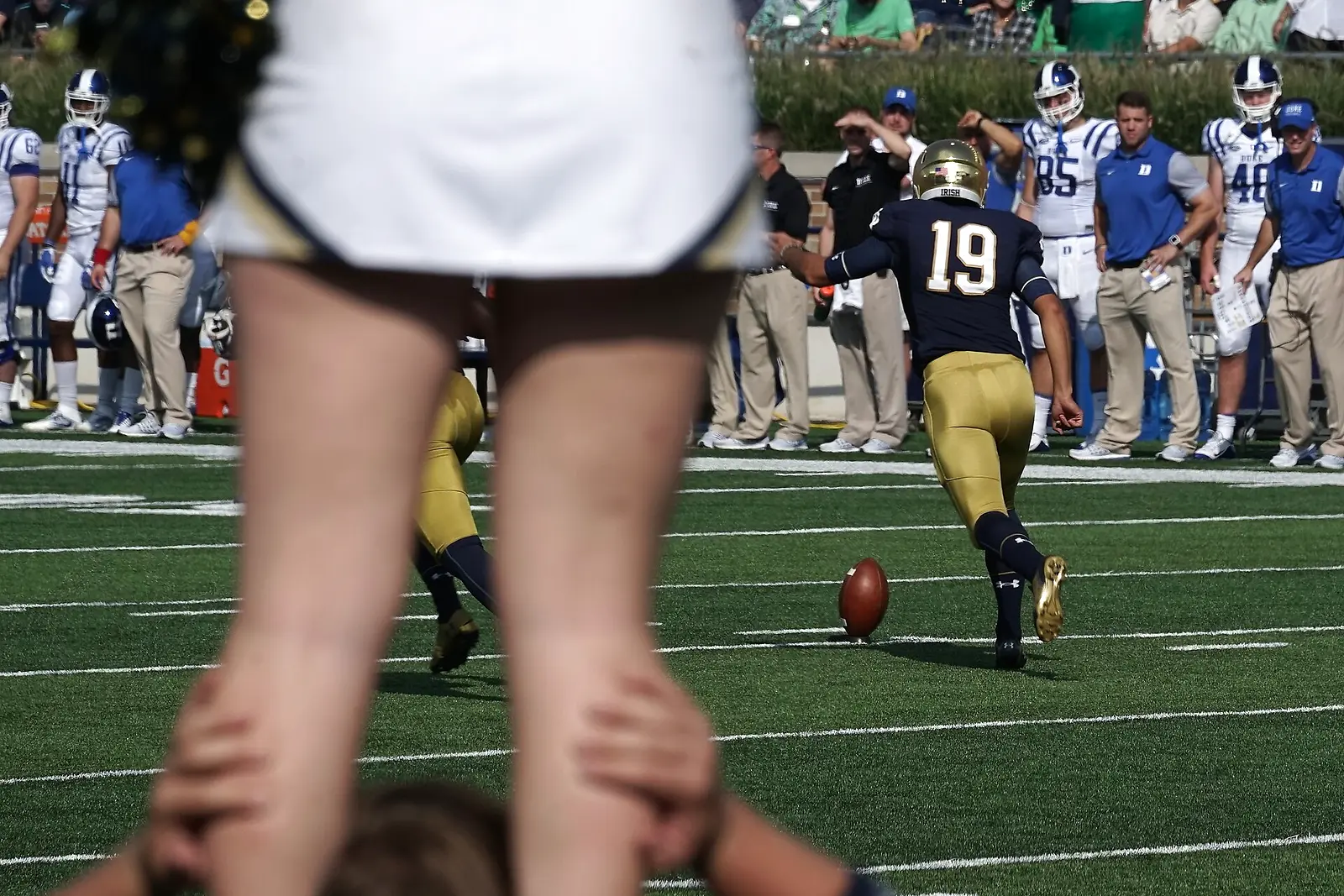
Notre Dame does not have to guess what disappeared from its offense. The number is 2,046 rushing yards.
Jeremiyah Love ran for 1,372 yards in 2025. Jadarian Price added 674. Together, they produced 73.5 percent of the Irish running backs’ rushing yards, scored 29 rushing touchdowns and averaged 6.6 yards per carry. Then both left for the NFL, with Love selected third overall and Price also becoming a first-round pick.
That is not a normal backfield transition. It is the removal of two explosive answers from an offense that averaged 5.7 yards per rush, more than 200 rushing yards per game and 7.3 yards per play. The loss could tempt Notre Dame to frame 2026 as a search for the next Love.
That would be the wrong assignment.
The most realistic replacement plan is not one running back. It is quarterback CJ Carr, a deeper receiving rotation and a formation structure that prevents defenses from devoting an extra body to the run. Notre Dame’s offense can remain elite, but it will have to become elite in a different way.
The production being replaced was unusually efficient
Love’s final season was not built on empty volume. Notre Dame’s official account of his 2025 production credits him with 1,372 yards and 18 touchdowns on 199 carries—6.9 yards per attempt—plus 280 receiving yards and three more scores. His 21 total touchdowns set a school record.
Price gave the same offense a second high-efficiency option. His Notre Dame biography lists 674 yards and 11 rushing touchdowns on 113 carries, a 6.0-yard average. He also returned two kickoffs for touchdowns and caught two touchdown passes.
Add the two rushing lines and Notre Dame received 2,046 yards and 29 touchdowns from 312 carries. That is one rushing touchdown every 10.8 attempts. Even a strong replacement backfield is unlikely to reproduce that scoring rate.
The deeper challenge is the type of value those backs created. Love could defeat a correct defensive call. Price could turn a routine crease into a field-position swing. Their explosive ability allowed Notre Dame to score before a drive accumulated many difficult decisions.
An offense can replace carries more easily than it replaces cheap touchdowns.
Carr already proved he can carry efficiency
Carr enters his second season as a starter with more evidence than the phrase “young quarterback” suggests. He completed 195 passes at a 66.7 percent rate for 2,741 yards and 24 touchdowns in 2025. He threw at least one touchdown pass in all 12 games and tied the program high for touchdown passes through a player’s first 12 career starts since 1966, according to his official Notre Dame profile.
His 9.35 yards per attempt and 14.06 yards per completion show that the accuracy was not produced by a diet of empty throws. Carr could push the ball without sacrificing control. His four-touchdown, 354-yard performance at Arkansas and 342-yard game against NC State demonstrated that Notre Dame could win through the pass when the game demanded it.
The question for 2026 is not whether Carr can throw more. It is whether a higher passing share can remain as efficient when defenses are less afraid of the backfield.
That distinction matters. Passing volume rises naturally when an offense loses two first-round running backs. Passing value rises only if Carr receives clean protection, the receivers create separation and the play design keeps the defense from narrowing its answers.
Notre Dame should not ask Carr to replace 2,046 rushing yards with 2,046 additional passing yards. It should ask him to preserve the favorable boxes and isolated matchups that Love and Price used to create.
The receiving room can change the math
Jordan Faison is the established connector. He caught 30 passes for 356 yards in 2025 and led the team in receiving four times, according to his official biography. His seven-catch, 89-yard performance against Indiana in the playoff showed he can remain involved when the opponent and leverage rise.
The ceiling depends on what grows around him. Micah Gilbert caught nine passes for 93 yards as a sophomore. Mylan Graham and Quincy Porter arrived from Ohio State, giving Carr additional size and pedigree on the outside. The 2026 roster also preserves enough bodies to rotate without making every third down dependent on one target.
That depth creates a tactical answer to the missing backfield. Notre Dame can use three-receiver sets to remove a defender from the box, throw quick access routes when a safety cheats toward the run and use motion to identify coverage before the snap. None of those choices guarantees a productive running game. Each one makes the box count more honest.
The best version of Carr’s 2026 season may therefore be measured indirectly. If opponents keep both safeties deep, the new backs receive lighter fronts. If a safety drops, Carr should have one-on-one opportunities outside. The quarterback’s leverage is not limited to the passes he completes; it includes the defenders he forces out of the run fit.
The offensive line is the bridge between identities
Left tackle Anthonie Knapp gives Notre Dame an unusually valuable point of continuity. He has started 27 games over two seasons and was named first-team preseason All-America by Walter Camp. The school’s June announcement connects his work directly to last season’s 5.7 yards per rush and 7.3 yards per play.
Knapp’s presence matters because an offense changing its center of gravity cannot also afford constant protection changes. A dependable tackle allows Notre Dame to release a tight end into a route, push a back into the pattern or slide help elsewhere. That creates more five-eligible-receiver concepts without turning every down into a protection gamble.
The line also gives the new backs a chance to be collectively useful before any one of them becomes individually dominant. Notre Dame does not need one player to absorb 312 carries. It needs a rotation that can stay on schedule, protect Carr and punish defenses when the box gets light.
The backs will still matter. Their job simply changes from replicating two first-round picks to completing the structure Carr creates.
Lambeau will reveal the new hierarchy immediately
Notre Dame opens against Wisconsin at Lambeau Field on September 6. The official schedule then sends Rice to South Bend before road games at Purdue and North Carolina.
That opener is a useful diagnostic because Wisconsin should test whether Notre Dame can produce efficient offense without leaning on the reputation of its former backfield. If the Irish repeatedly face third-and-long, the transition is not complete. If Carr creates explosives early and the new backs run into manageable numbers, the offense’s new hierarchy will be visible.
The rest of the schedule adds a different kind of pressure. There is no USC game in 2026, but Miami, Florida State and Syracuse remain major résumé points. Notre Dame’s independence means it does not have a conference championship game to repair a narrow miss. After the Irish went 10-2 and still missed the 2025 playoff, style and schedule strength will remain part of every evaluation.
That increases the value of offensive control. Notre Dame cannot merely survive the backfield transition. It needs a profile that looks complete enough to withstand the playoff committee’s comparisons.
What success should look like
The wrong benchmark is another 6.6 yards per carry and 29 rushing touchdowns from the top two backs. That asks new personnel to imitate rare personnel.
A better benchmark begins with Carr. If he stays near nine yards per attempt, keeps his completion rate above 65 percent and reduces the number of possessions that require the run game to rescue third down, Notre Dame will have transferred responsibility without losing efficiency.
The receiving room should produce more distributed value. Faison does not need 100 catches. Notre Dame needs three or four players capable of winning a coverage-specific assignment so opponents cannot load the box and double the only trusted receiver.
The running backs need to be efficient enough to punish that defensive spacing. They do not need to create every explosive. A 4.8-yard gain against a light box keeps the offense on schedule and forces the defense to reconsider how it treats Carr.
This is the central trade: fewer impossible runs from special backs, more repeatable advantages created by the quarterback.
The StatTake conclusion
Notre Dame lost two first-round running backs who combined for 2,046 rushing yards, 29 rushing touchdowns and one of the country’s most efficient backfield pairings. There is no honest way to call that loss small.
There is also no reason to assume the offense must decline in direct proportion to the missing production.
Carr already produced 2,741 yards, 24 touchdown passes and high-end efficiency in his first season as the starter. Knapp anchors the protection. Faison returns as a trusted target, and the receiver room has more ways to distribute coverage stress.
The 2026 offense should belong to the quarterback first. Carr’s job is not to impersonate Love or Price. It is to make sure Notre Dame never needs one player to do so.
That is a different offensive identity. It may also be the one that gives Notre Dame a higher playoff ceiling.
Down-to-down performance with less credit for isolated, high-variance plays.
EXPLOSIVE DEP.PENDINGV1.0-provisionalHow much an offense relies on explosive plays rather than sustainable down-to-down production.
RESUMEPENDINGV1.0-provisionalWhat a team has accomplished, with explicit credit for opponent, location and quality wins.
WHAT’S YOUR TAKE?
Keep it about the game.
YOUR TAKE BELONGS IN THE CONVERSATION.
Create a free StatTake account to comment beneath full articles. Sign in with a private code sent to your email—no extra password.
- Comment beneath every full article
- Choose one public username
- Keep your email private
Loading comments…