


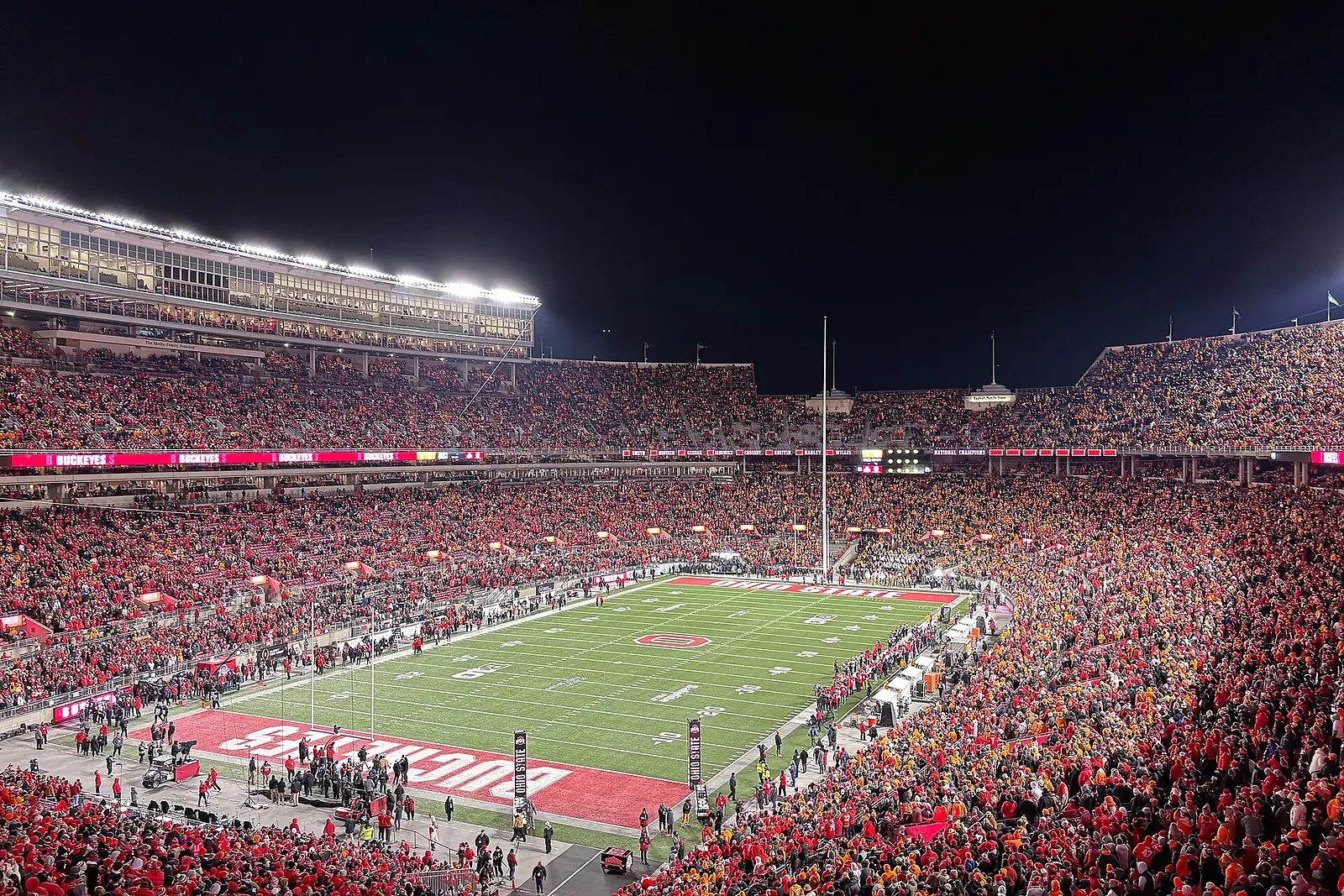
A championship can be a perfect roster. Two can be a trend. Three consecutive titles from three different schools require a larger explanation.
Michigan won the 2024 College Football Playoff championship, Ohio State followed in 2025 and Indiana completed a 16–0 title season in 2026. The Big Ten's record-revenue announcement pairs that run with a second number: $1.37 billion distributed to 18 member institutions for the fiscal year ending June 30, 2025.
That was $490 million more than the previous year's $883 million distribution—an increase of roughly 55.5 percent. The title run and the revenue are not the same accomplishment. Together, they describe a conference whose competitive and financial center is widening.
Three schools make the streak structural
If one program had won all three championships, the simplest explanation would be a dynasty. The Big Ten produced three champions with different identities.
Michigan won with line play, defense and a veteran structure. Ohio State converted elite talent into a postseason run. Indiana's undefeated breakthrough expanded the set of programs capable of reaching the summit.
That variety matters because it reduces dependence on one coach or recruiting cycle. The league has shown multiple paths to a title, which makes future contention more durable.
Revenue raises the floor before it raises the ceiling
The $1.37 billion distribution reflected the first full year of the conference's current media agreements and its first year with Oregon, UCLA, USC and Washington as members. A simple division across 18 schools equals about $76.1 million per institution, although the conference release does not say every school received an identical amount.
The most important effect of revenue is not a direct purchase of wins. It is the reduction of weak links: better retention systems, deeper support staffs, improved recovery, broader recruiting operations and more capacity to absorb mistakes.
Money can be wasted. It also gives more programs the chance to build championship infrastructure if leadership and evaluation are strong.
The 2026 schedule will test the depth of the claim
The Big Ten's official schedule release highlights an October 17 meeting between Indiana and Ohio State, the two most recent champions. That game will be treated as a title-rematch event, but the larger test is the league around it.
Oregon, Penn State, USC, Michigan and others do not need to match the champions' exact formulas. They need to demonstrate that the conference's top tier remains crowded after expansion. If the league produces several nationally elite efficiency profiles again, the three-title streak will look less like a closed chapter and more like the start of an era.
The StatTake conclusion
The Big Ten's claim is now stronger than brand size or media reach. Three different programs have delivered the last three national championships, while the conference's annual distribution reached a record $1.37 billion.
That does not guarantee a fourth title. It does change the burden of proof. The league no longer needs to show it can produce one exceptional program. The rest of college football must show that the Big Ten's expanding system can be interrupted.
Production above or below the output expected from roster talent, experience and returning production.
RESUMEPENDINGV1.0-provisionalWhat a team has accomplished, with explicit credit for opponent, location and quality wins.
EFFICIENCYPENDINGV1.0-provisionalDown-to-down performance with less credit for isolated, high-variance plays.
WHAT’S YOUR TAKE?
Keep it about the game.
YOUR TAKE BELONGS IN THE CONVERSATION.
Create a free StatTake account to comment beneath full articles. Sign in with a private code sent to your email—no extra password.
- Comment beneath every full article
- Choose one public username
- Keep your email private
Loading comments…