


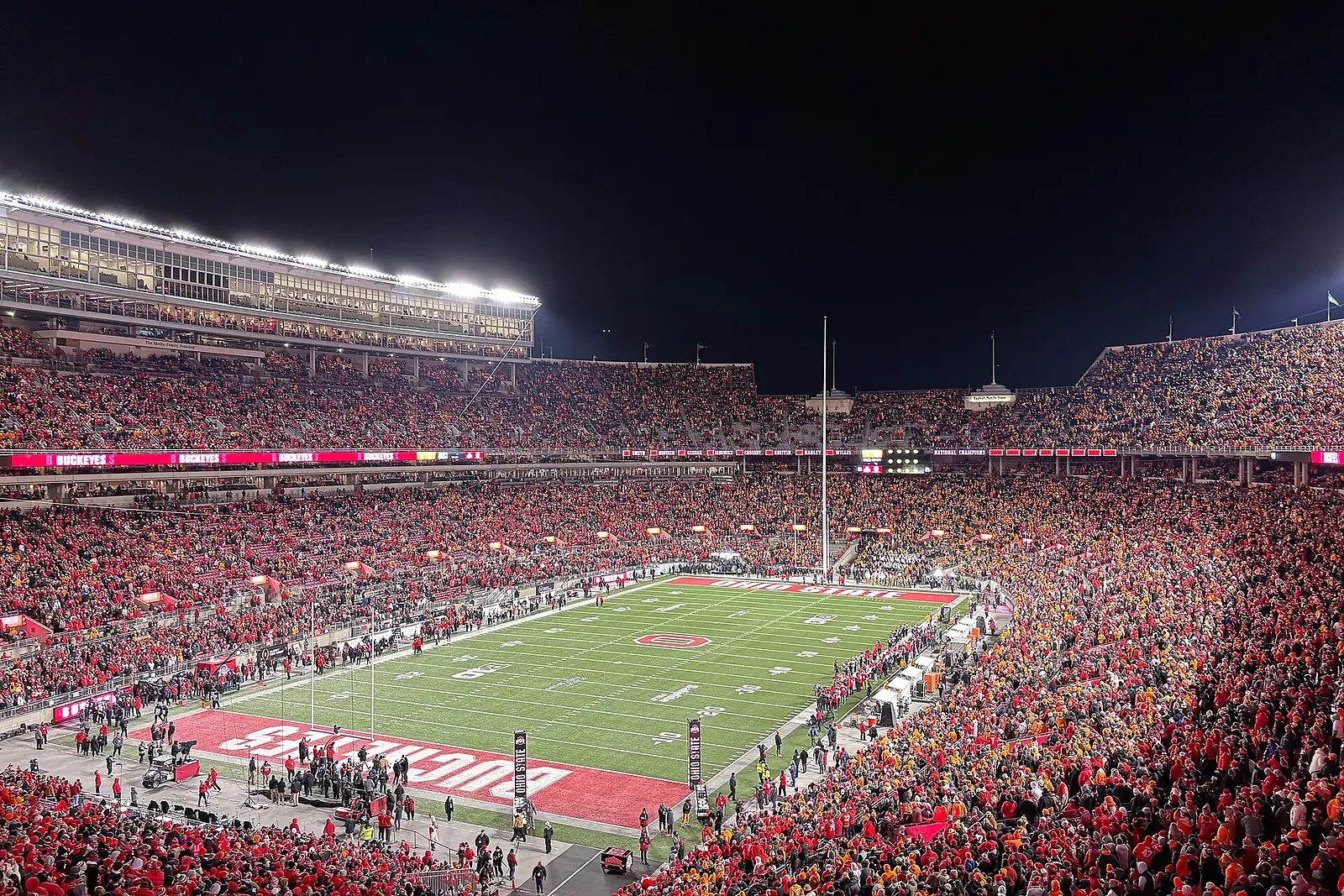
The Big Ten begins 2026 with the country’s No. 1 team, No. 2 team and defending national champion. The underlying numbers are even stronger than the poll.
Ohio State finished first nationally in StatTake’s 2025 EPA margin. Oregon finished second. Indiana finished sixth and led the nation in opponent-adjusted EPA margin. The three also occupied three of the top 11 spots in defensive EPA allowed and three of the top 12 in offensive EPA per touch.
That is not merely a conference with three famous brands near the top. It is a tier whose best teams produced elite value on both sides of the ball, then retained or replaced enough at quarterback to make the performance plausible again.
The Big Ten’s August 20 AP poll breakdown placed eight teams in the Top 25: Ohio State first, Oregon second, Indiana sixth, USC 14th, Michigan 16th, Washington 17th, Penn State 18th and Iowa 22nd. The familiar question is whether the league can place several teams in the playoff. The better one is how many teams below the top three can generate evidence stronger than a ranking inherited in August.
Why the top three are not living on reputation
The StatTake 2025 EPA board gives Ohio State the nation’s No. 1 EPA margin, Oregon No. 2 and Indiana No. 6. Ohio State ranked fourth in defensive EPA allowed and 10th on offense. Oregon was third on offense and seventh on defense. Indiana finished 12th and 11th, respectively, while ranking first after opponent adjustment.
Each profile answers a different sustainability question.
Ohio State has the best proven quarterback-receiver combination. Julian Sayin completed 77.0 percent of his passes for 3,610 yards, 32 touchdowns and eight interceptions. The completion rate was a Big Ten record and third-highest single-season figure in FBS history. Jeremiah Smith has 2,558 receiving yards and 27 touchdowns through two college seasons, the most in the nation over that span. Those figures come from Ohio State’s official preseason honors release, not projection.
The Buckeyes’ risk is concentration. When an offense has an obvious best receiver, elite opponents can devote structure to changing where the ball goes. Smith still creates value when bracketed, but Ohio State’s title ceiling depends on the second and third answers remaining efficient.
Oregon owns the most complete returning offensive structure. Dante Moore returns with receivers Dakorien Moore, Evan Stewart and Jeremiah McClellan and running backs Jordon Davison and Dierre Hill Jr. The Ducks ranked third nationally in offensive EPA, sixth in success rate and eighth in points per drive. Their defense ranked seventh in EPA allowed and 10th in points allowed per drive.
That balance makes Oregon the least dependent on one statistical category. A lower explosive-play rate would hurt but not collapse the offense. A difficult passing matchup does not erase the run game. A bad drive does not expose a defense built only to protect leads.
Indiana’s test is replacement, not validation. The Hoosiers went 16-0, won the national championship and finished first in opponent-adjusted EPA margin. Fernando Mendoza, Elijah Sarratt and Omar Cooper Jr. are gone, but Josh Hoover arrives from TCU after throwing for 3,472 yards and 29 touchdowns in 2025. Nick Marsh joins Charlie Becker in the receiving room, and the offensive line remains a strength.
Hoover also threw 13 interceptions. Indiana’s structure should reduce the need for reckless volume, but the defending champion cannot assume that new players reproduce a 52.7 percent offensive success rate, second nationally. That number is both proof of system quality and an exceptionally high baseline.
Tier 1 — Ohio State, Oregon and Indiana are national-title teams
Ohio State is the conference pick by the narrowest margin. Its defense allowed only 0.88 points per drive, second nationally, and its offense produced 3.71. The Buckeyes can win high-possession games, low-possession games and the games in which a quarterback must create late.
Oregon is closer than the No. 2 label implies. Its 0.359 EPA margin trailed Ohio State’s 0.366 by only seven-thousandths of a point per play. The Ducks also finished with a slightly better offensive EPA figure. The difference is defensive dominance: Ohio State was fourth in EPA allowed; Oregon seventh. That is a real edge, not a gulf.
Indiana deserves to remain in the tier because its 2025 efficiency was not turnover smoke. Opponent adjustment moved the Hoosiers up, not down, to No. 1. Their defense allowed 0.95 points per drive, third nationally, and their offense ranked second in success rate. Regression is reasonable. Collapse is not the default.
All three have playoff-level floors. The conference race will be decided by injuries, head-to-head games and how Indiana’s replacements handle the leverage moments a veteran championship roster controlled last year.
Tier 2 — USC and Washington have the production; Michigan has the reconstruction
USC and Washington were quietly elite offensive teams. USC ranked 14th in EPA margin, seventh on offense, seventh in offensive success rate and fifth in points per drive. Washington ranked 16th overall, 19th on offense and 31st in defensive EPA allowed.
USC returns an FBS-high 15 starters, including quarterback Jayden Maiava. Gary Patterson takes over the defense after building five national total-defense leaders at TCU. The case for a USC breakout is straightforward: preserve an offense that created 3.66 points per drive and make a defense ranked 60th in EPA allowed merely good.
The risk is schedule and proof. Defensive-coordinator reputation is not defensive performance. Patterson must show that USC can tackle, prevent explosive plays and survive the week-to-week physical cost of the Big Ten. If the defense rises into the top 35, the Trojans are a playoff team. If it stays around 60th, the offense will again be asked to win every important fourth quarter.
Washington returns Demond Williams Jr. after a 2025 season of more than 3,000 passing yards, 25 passing touchdowns and 611 rushing yards. The Huskies’ profile was balanced enough to travel, but the pass rush and corner depth determine whether a top-20 offense becomes a contender or a dangerous nine-win team.
Michigan is the tier’s philosophical change. Kyle Whittingham replaces Sherrone Moore and inherits Bryce Underwood for his second season as the starting quarterback. Michigan finished 35th in EPA margin, 49th on offense and 38th in defensive EPA allowed. Those are good, not elite, numbers. Whittingham’s Utah teams were defined by defense, development and game-state control. The Wolverines need his floor immediately while Underwood raises the offensive ceiling.
The concern is timing. A coaching transition can improve a program’s long-term identity while creating short-term communication costs. Michigan has enough talent to challenge the top three, but less continuity than Ohio State or Oregon and less recent proof than Indiana.
Tier 3 — Penn State, Iowa and the break-up-or-down middle
Penn State is the conference’s most ambitious reboot. Matt Campbell arrives after James Franklin’s midseason dismissal and brings a large Iowa State contingent, including quarterback Rocco Becht, tight end Ben Brahmer, running back Carson Hansen and linebacker Caleb Bacon. The Nittany Lions’ portal class ranked fourth nationally in the final June 247Sports-based list.
That acquisition strategy buys familiarity. It does not guarantee that a system producing modest Big 12 offense instantly scales against Ohio State, Oregon and Michigan. Penn State ranked 29th in EPA margin, 30th on offense and 55th in defensive EPA allowed during a 7-6 season. Campbell has enough talent to move the floor quickly; the question is whether the transfer core raises the ceiling or simply recreates Iowa State in a more talented uniform.
Iowa is the opposite experiment. The Hawkeyes ranked 40th in EPA margin, 77th on offense and 16th in defensive EPA allowed. They do not need a new identity. They need enough offense to stop turning every game into a referendum on defensive perfection. A move from 77th to even 45th would make Iowa a legitimate conference spoiler.
Illinois, Nebraska, Minnesota and Northwestern form the true swing tier. Illinois ranked 74th in EPA margin despite a 9-4 record because its defense finished 97th in EPA allowed. Nebraska was 82nd, with a defense ranked 83rd. Minnesota fell to 101st and ranked 108th after opponent adjustment.
Northwestern is the most interesting of the four. The Wildcats hired Chip Kelly as offensive coordinator and named Aidan Chiles the starting quarterback. Chiles brings 20 starts, 3,807 passing yards, 23 touchdowns and 14 interceptions from Michigan State. Northwestern ranked 89th in EPA margin and 86th in defensive EPA allowed. Kelly can lift the offense; the defense decides whether the change produces wins or merely more entertaining losses.
Tier 4 — the bottom needs structural repair
Wisconsin finished 130th in EPA margin and 132nd in offensive EPA per touch. Purdue was 127th in margin and 125th in defensive EPA allowed. UCLA ranked 122nd in margin and 122nd on defense. Rutgers was 111th overall and 134th—last in the dataset—in defensive EPA allowed.
Those teams are not one quarterback away. They need multiple position groups to improve at once.
Wisconsin’s defense remained closer to average than its record suggested, but the offense produced 1.37 points per drive, 131st nationally. Purdue’s offense ranked 101st and defense 125th. UCLA’s offense ranked 95th and defense 122nd. Rutgers had the most deceptive positive: 41st in offensive EPA, erased by the country’s worst defense.
Michigan State, 105th in margin, also begins a new coaching era under Pat Fitzgerald. The Spartans added experience through the portal, but a defense ranked 103rd in EPA allowed needs more than veteran names. It needs a pass rush and coverage plan that work together.
Why the middle matters to the playoff
The Big Ten’s eight ranked teams create opportunity and danger. Ohio State, Oregon and Indiana will collect ranked wins only if the middle remains ranked. USC, Michigan, Washington and Penn State need each other to become résumé multipliers rather than preseason placeholders.
If USC’s defense improves, Michigan adapts quickly and Penn State’s portal rebuild works, the Big Ten can support four credible playoff cases. If those teams cannibalize one another while producing merely average efficiency, the league may look deep in the polls but concentrated in the data.
Ohio State travels to Texas on September 12, and Michigan plays Oklahoma. Later conference games place Ohio State at Indiana and send Oregon into a schedule filled with ranked opponents. The top three have chances to prove national strength. The middle must ensure those games are not the league’s only high-value evidence.
The StatTake conclusion
Ohio State is the Big Ten pick because it combines the nation’s best EPA margin with a quarterback who completed 77 percent of his passes and the country’s most productive two-year receiver. Oregon is functionally even and may own the deeper offensive menu. Indiana is the defending champion with the strongest opponent-adjusted profile, but the most important quarterback and receiver turnover.
USC is the breakout choice because its offense was already playoff caliber and its defensive change targets the exact weakness. Washington is the dangerous continuity team. Michigan is the high-upside coaching bet. Penn State is the portal experiment whose result will tell us how easily imported familiarity becomes Big Ten contention.
The conference is top-heavy only if the analysis stops at the top. Three top-six EPA teams make the Big Ten formidable. Four more ranked teams with specific, solvable questions make it the country’s most consequential middle.
Down-to-down performance with less credit for isolated, high-variance plays.
DEVELOPMENTPENDINGV1.0-provisionalHow effectively a program improves, retains and converts players relative to their starting expectations.
TALENT ROIPENDINGV1.0-provisionalProduction above or below the output expected from roster talent, experience and returning production.
WHAT’S YOUR TAKE?
Keep it about the game.
YOUR TAKE BELONGS IN THE CONVERSATION.
Create a free StatTake account to comment beneath full articles. Sign in with a private code sent to your email—no extra password.
- Comment beneath every full article
- Choose one public username
- Keep your email private
Loading comments…