

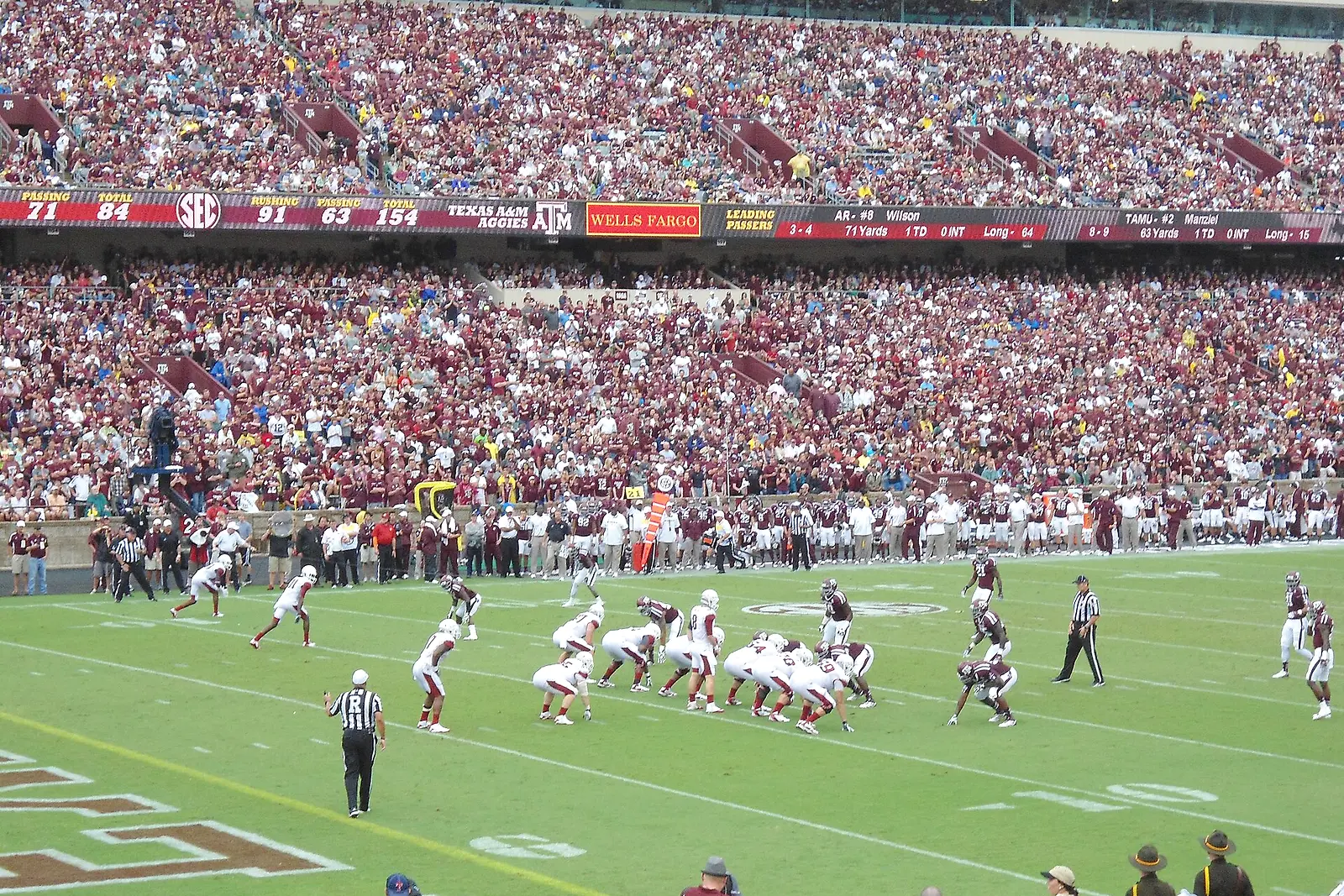
Texas A&M beat Arizona State 48–20, and the scoreboard practically begs us to declare the Aggies’ offense fixed.
Don’t do it.
The No. 10 Aggies won because their defense and special teams wrecked the game. Marco Jones and Julio Humphrey returned interceptions for fourth-quarter touchdowns. Texas A&M forced four turnovers, scored 21 points off them and repeatedly started with a short field. That is a terrific formula for winning one Saturday. It is not evidence of an elite offense.
Arizona State actually outgained A&M 369–255. The Sun Devils produced more first downs, more passing yards and more rushing yards. Texas A&M averaged 2.6 yards per carry, converted 3 of 12 third downs and held the ball for eight fewer seconds than Arizona State. Strip away the return touchdowns and this looks nothing like a 28-point offensive demolition.
Marcel Reed was efficient, not dominant
Marcel Reed completed 15 of 25 passes for 163 yards, three touchdowns and one interception. Isaiah Horton caught two of those scores. Mario Craver caught the other. Reed deserves credit for cashing in the opportunities the rest of the team created.
But 6.5 yards per attempt is not a number that should end questions about the passing game. Neither is 92 rushing yards on 35 attempts. Arizona State receiver Reed Harris alone produced 189 receiving yards—26 more yards than A&M’s entire passing offense.
The final box score makes the separation clear. Texas A&M’s defense created 100 interception-return yards and two touchdowns. The offense generated 255 yards from scrimmage. When the defense becomes that productive, the final score stops being a clean measure of how well the offense played.
That is not criticism of Mike Elko’s defense. It is praise with a warning attached. Jones’ 55-yard pick-six and Humphrey’s 45-yard return turned a 27–20 game into a rout in less than three minutes. Great teams punish mistakes. The Aggies did it ruthlessly.
Special teams tilted the field, too. Terry Bussey’s 21-yard punt return helped create a third-quarter touchdown, while Arizona State’s muffed punt and failed fake punt handed A&M extra possessions. The Aggies were sharper in the hidden-yardage moments. That matters. It still does not transform 255 offensive yards into something they were not.
The counterargument is that style does not matter when all three phases complement one another. A&M committed only one penalty, protected the ball reasonably well and turned field position into points. Reed threw a touchdown on three of his 15 completions. Maybe asking for more is nitpicking.
It is not—not for a top-10 team with playoff expectations. Defensive touchdowns are high-value events, but they are not a stable weekly plan. There will be afternoons when the ball does not bounce into a defender’s hands and the offense has to drive 75 yards against a set defense.
Texas A&M learned that its defense can turn a competitive game into a blowout. That is real. The offense learned much less. Until 255 yards and 2.6 per rush improve, the 48 beside A&M’s name should tell us who finished the game—not which unit is ready to carry the season.
The ability to create first downs and points without depending on a single explosive play.
RESILIENCEPENDINGV1.0-provisionalHow frequently an offense recovers after sacks, penalties and other drive-threatening setbacks.
NO-LUCKPENDINGV1.0-provisionalA turnover-neutral view of team quality built from the components most likely to persist.
WHAT’S YOUR TAKE?
Keep it about the game.
YOUR TAKE BELONGS IN THE CONVERSATION.
Create a free StatTake account to comment beneath full articles. Sign in with a private code sent to your email—no extra password.
- Comment beneath every full article
- Choose one public username
- Keep your email private
Loading comments…