

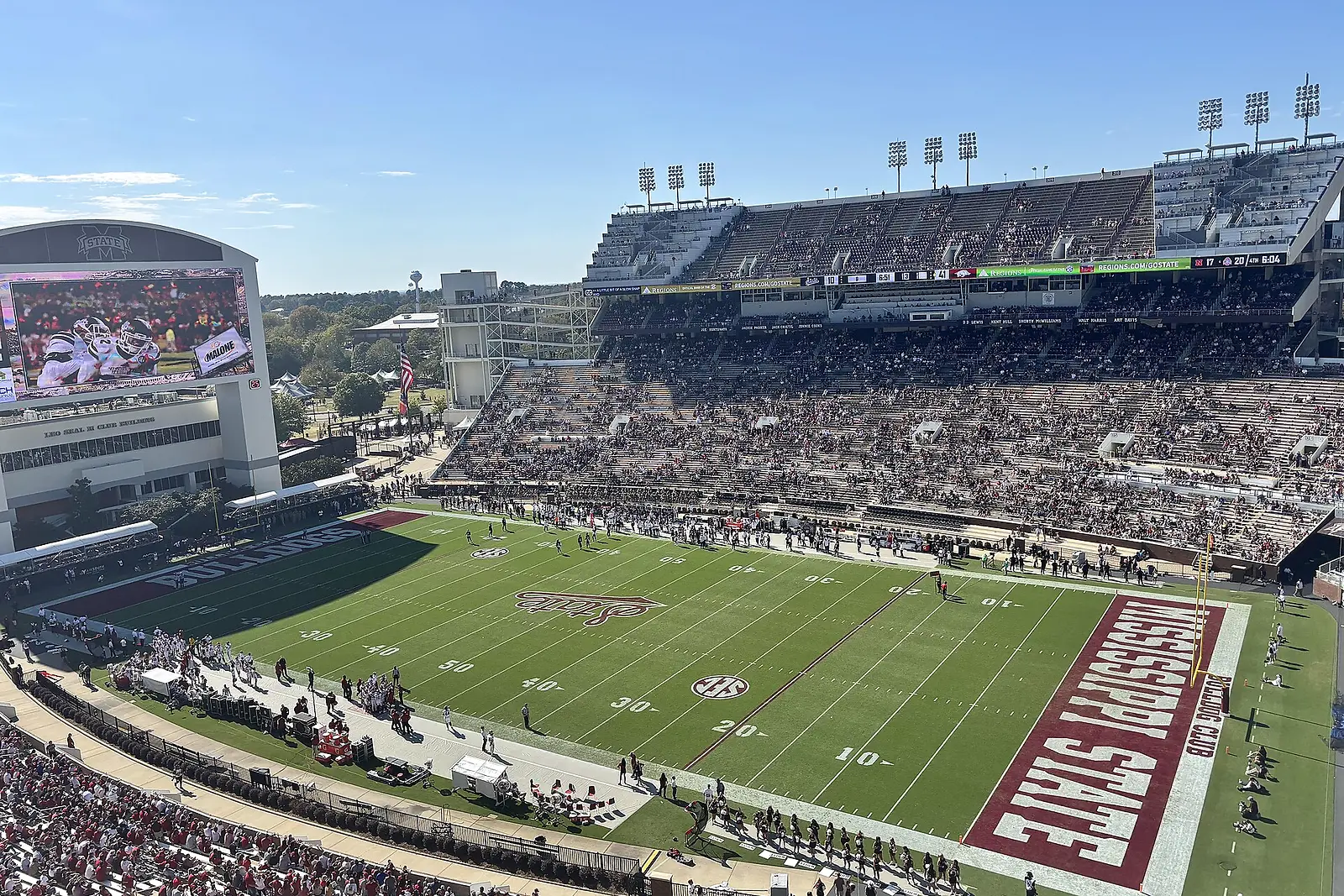
Mississippi State did not need a turnover avalanche, a special-teams touchdown or one bizarre bounce to beat Minnesota 38–13. The Bulldogs actually lost the turnover battle, 1–0.
That is what makes this result worth more than one comfortable September win.
The obvious explanation will be that Minnesota imploded. The Gophers committed 12 penalties for 115 yards and abandoned the run. Both are true. Neither explains how completely Mississippi State controlled the parts of football that tend to travel.
The Bulldogs gained 479 yards, including 252 on the ground. Minnesota finished with 13 rushing yards—not 113, thirteen—on 15 attempts. State won first downs 28–18, converted 6 of 10 third downs and averaged 5.5 yards per rush. When one team can run and the other cannot, the turnover column becomes much less powerful.
Kamario Taylor changed the shape of the offense
Kamario Taylor was not merely efficient. He made Minnesota defend every gap and every level.
The sophomore completed 16 of 22 passes for 227 yards, three touchdowns and no interceptions. He also ran 13 times for 86 yards. That is 313 yards of total offense on 35 direct touches, with no giveaway charged to him.
His presence created clean work for everyone else. Fluff Bothwell ran for 113 yards and two touchdowns on 18 carries. Anthony Evans III caught seven passes for 121 yards and a score. State averaged 10.3 yards per pass attempt without becoming one-dimensional, then leaned on the run without becoming predictable.
The official Mississippi State box score shows four consecutive touchdown drives in the first half. The Bulldogs covered 64, 71, 72 and 76 yards on those possessions. That was not field-position charity. It was an offense repeatedly moving the length of the field.
It also happened on the road, where communication and third-down execution are supposed to become harder. State did not shorten the game to protect Taylor. It let him dictate it.
Minnesota never scored an offensive touchdown. Its 13 points came from two field goals and a defensive fumble return. Drake Lindsey completed 31 passes, but needed 48 attempts to reach 279 yards. That is 5.8 yards per throw—the statistical shape of an offense chasing a game without threatening it.
The strongest counterargument is that Minnesota helped create the mismatch. Twelve penalties destroyed manageable downs, and 15 rushing attempts meant the Gophers never forced State’s front to survive a balanced plan. One nonconference win does not make the Bulldogs an SEC contender.
Fair. But dismissing the result as Minnesota malfunctioning ignores why it malfunctioned. Mississippi State scored on four straight long drives, forced the Gophers to chase and then made their running game irrelevant. The Bulldogs imposed the script.
The verdict is not that Mississippi State has jumped to the front of the SEC. It is that the program no longer looks like a free square on an SEC schedule. Taylor’s dual-threat control and a 252-yard run game give the Bulldogs a repeatable identity. After winning by 25 while receiving no turnover help, that identity deserves to be taken seriously.
The ability to create first downs and points without depending on a single explosive play.
NO-LUCKPENDINGV1.0-provisionalA turnover-neutral view of team quality built from the components most likely to persist.
POWERPENDINGV1.0-provisionalOpponent-adjusted team quality designed to describe how strong a team is right now.
WHAT’S YOUR TAKE?
Keep it about the game.
YOUR TAKE BELONGS IN THE CONVERSATION.
Create a free StatTake account to comment beneath full articles. Sign in with a private code sent to your email—no extra password.
- Comment beneath every full article
- Choose one public username
- Keep your email private
Loading comments…