

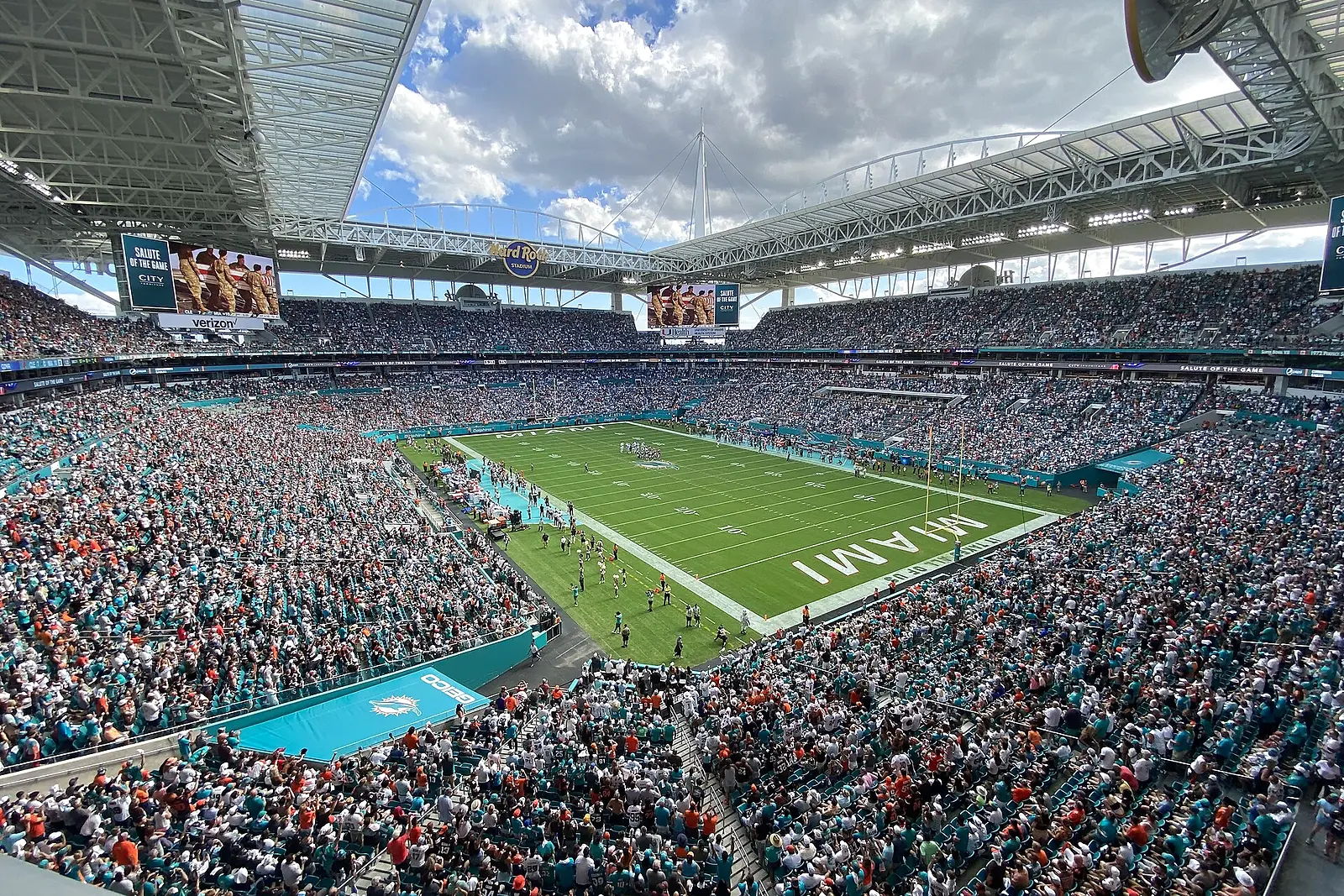
Miami begins 2026 with nearly everything a conference favorite is supposed to possess: the preseason player of the year, the deepest collection of preseason All-ACC selections, a top-five portal class and 165 of 188 first-place votes in the league’s media poll.
The Hurricanes do not begin with separation in the efficiency data.
Miami finished 11th nationally in StatTake’s 2025 EPA margin. SMU finished 13th. Their difference was 0.0034 expected points per play—about one-third of one-hundredth. Miami ranked seventh after opponent adjustment; SMU ranked 10th. Miami’s defense was 14th in EPA allowed; SMU’s was eighth.
Then Miami added the quarterback who led Duke to the ACC championship.
Darian Mensah threw for 3,973 yards and 34 touchdowns in 2025, both second nationally, and only six interceptions. He also brought top target Cooper Barkate, who caught 72 passes for 1,106 yards and seven scores. The transaction gives Miami the league’s highest-confidence upgrade at the sport’s most important position.
It does not turn the ACC into a one-team league.
The favorite has evidence, not just attention
The official ACC media poll gave Miami 3,159 points, 365 more than second-place SMU. Louisville placed third, Clemson fourth and Georgia Tech fifth. The vote also exposed how uncertain the middle is: Virginia, NC State and Virginia Tech were separated by only 19 points from sixth through eighth.
Miami’s case improved the next day when Mensah was named preseason ACC Player of the Year. The Hurricanes placed nine players on the preseason team. Malachi Toney appeared three times—as a receiver, all-purpose player and specialist—after winning 2025 ACC Freshman of the Year.
The 2025 numbers support the defense. Miami allowed 1.28 points per drive, eighth nationally, and ranked 14th in defensive EPA allowed. The offense was good rather than dominant: 28th in EPA per touch, 13th in success rate and 23rd in points per drive. Mensah therefore arrives at a program whose clearest upgrade path is exactly where he plays.
The transfer ranking reinforces the choice. Miami’s class finished fifth nationally in the final June 247Sports-based rankings, led by Mensah, Barkate and Missouri edge Damon Wilson. This is not depth added around a settled roster; it is targeted replacement at quarterback, receiver and pass rush.
The sustainability question is protection. Mensah operated Duke’s offense at high volume and won the conference, but Miami still must replace parts of an offensive line that helped control possession in 2025. A quarterback can recognize pressure and create answers. He cannot make five new combinations communicate like a veteran unit in September.
Tier 1 — Miami leads; SMU and Louisville have real paths
SMU’s statistical proximity is the reason the ACC should resist coronation. The Mustangs ranked 13th in EPA margin, 10th after opponent adjustment, eighth in defensive EPA allowed and 27th in points allowed per drive. Their offense was only 34th in EPA per touch, but Kevin Jennings returns after throwing for 3,641 yards and 26 touchdowns in 2025.
Jennings also threw 13 interceptions, third-most in the FBS. That is the entire SMU swing in one line. A healthy quarterback with nearly 7,000 passing yards over two seasons gives the Mustangs a veteran floor. Reducing the handful of decisions that create short fields could turn an already top-15 overall profile into a title winner.
SMU’s 2025 red-zone split—scores on 40 of 44 trips while opponents scored on 33 of 47—shows why the defense and game management mattered. The Mustangs survived without owning every snap. That can repeat if Jennings protects possessions. It becomes fragile if turnovers erase the defense’s work.
Louisville is the third true contender because its best players affect both game script and leverage. Running back Isaac Brown averaged 8.75 yards per carry in 2025, the best mark in the country by more than a yard, while edge Clev Lubin supplies proven disruption. The Cardinals’ overall EPA margin ranked only 39th, but their defense was 15th in EPA allowed and 11th in points allowed per drive.
The offense ranked 82nd in EPA per touch and 69th in points per drive. Brown can create cheap yards and explosives, but Louisville must make ordinary passing downs more efficient. The Cardinals’ No. 13 transfer class adds help; Jeff Brohm’s larger task is reducing the number of games that reach the final possession. Seven of Louisville’s eight losses over the last two seasons came by one score.
Miami has the best roster. SMU has the closest two-year quarterback continuity. Louisville has the most credible upset formula. All three can reach Charlotte.
Tier 2 — Clemson, Virginia and the teams whose records disagree with their snaps
Clemson’s 7-6 record created the loudest disappointment, but its 2025 efficiency was not a collapse. The Tigers ranked 43rd in EPA margin, 44th adjusted, 46th on offense and 45th in defensive EPA allowed. Those are middle-class numbers attached to elite expectations.
Christopher Vizzina replaces Cade Klubnik at quarterback, and T.J. Moore returns as a preseason Biletnikoff candidate. Clemson also placed four players on the preseason All-ACC team. The breakout case rests on development, not a massive imported roster. That is both Dabo Swinney’s philosophical strength and the roster’s risk: Clemson needs several good players to become excellent simultaneously.
Virginia went 11-3 and finished sixth in the media poll, but ranked 28th in EPA margin and 39th after opponent adjustment. The Cavaliers were 56th in offensive EPA and 22nd in defensive EPA allowed. That is a strong season with some regression indicators, especially after quarterback change. The defense provides a real floor; the offense must prove the close-game success was not carrying more weight than the down-to-down profile.
Wake Forest is the inverse public story. The Demon Deacons were 31st in EPA margin and 32nd adjusted but were picked 13th by the media. Their defense ranked ninth in EPA allowed. Jake Dickert’s first season produced a 9-4 record and a clear identity. Wake is not loaded with national names, but a top-10 defensive EPA unit deserves more respect than its ballot position.
Florida State and Georgia Tech are the volatility teams. Florida State ranked 23rd in offensive EPA and 71st in defensive EPA allowed during a 5-7 season. Georgia Tech ranked 22nd and 84th, respectively, and loses ACC Player of the Year Haynes King. Both can score. Neither owns a defense that makes the offense’s weekly burden reasonable.
Tier 3 — NC State, Pitt, Duke and the middle that can break either way
NC State’s offense ranked 20th in EPA per touch, but the defense ranked 111th in EPA allowed and 104th in points allowed per drive. Quarterback CJ Bailey returns after eight of his nine 2025 interceptions came against Duke, Notre Dame and Miami. The pattern is useful: NC State can punish average opponents; its quarterback and defense must prove they travel upward against elite ones.
Pitt ranked 37th in EPA margin and 36th adjusted with no extreme weakness. That makes the Panthers a classic eight-win threat: capable of beating a contender, unlikely to dominate the league without a star phase. Pat Narduzzi’s defense was 39th in EPA allowed. The offense was 50th. Balance creates stability but not automatic separation.
Duke faces the most direct identity loss. The Blue Devils won the ACC, then watched Mensah and Barkate move to Miami. Their 2025 EPA margin ranked 76th, while the offense ranked 29th and defense 120th. The championship deserves full credit; the underlying profile says the roster was already winning with a narrow margin for error before losing its best quarterback.
California has the most intriguing individual development bet. Jaron-Keawe Sagapolutele threw for 3,454 yards and 18 touchdowns as a true freshman, including only two interceptions over his final seven games. New coach Tosh Lupoi kept him, but Cal’s team profile ranked 97th in EPA margin and 106th in offensive success rate. A quarterback jump can lift the Bears into the middle; it cannot alone erase a defense ranked 67th in EPA allowed.
Tier 4 — Virginia Tech can escape; Syracuse, North Carolina and Stanford need proof
Virginia Tech is the bottom-tier program with the best reason to move. James Franklin takes over after Penn State, and the Hokies assembled a top-10 portal-impact class by net-win estimates. The baseline is poor: 116th in EPA margin, 83rd after opponent adjustment and 130th in defensive EPA allowed. Franklin is not polishing a nine-win roster. He is rebuilding one of the league’s least efficient defenses.
The portal can accelerate competence because transfers bring playable snaps. It cannot guarantee cohesion. Virginia Tech’s early test is whether the defense can reduce explosive damage without becoming passive. If it rises from 130th to the top 75, the Hokies can reach the congested middle. That would be major progress, not instant contention.
Syracuse finished 133rd in EPA margin and 128th adjusted, with a defense 128th in EPA allowed. North Carolina was 119th overall and 106th adjusted after Bill Belichick’s 4-8 debut. Stanford ranked 117th in margin and 121st on offense while beginning another coaching transition under Tavita Pritchard. Boston College ranked 100th and 102nd adjusted.
Those profiles define stuck more precisely than a losing record. Each program needs more than favorable turnover luck or one transfer quarterback. Syracuse must stop explosive drives. North Carolina must create an offensive identity. Stanford must build Power Four depth. Boston College must improve a defense ranked 112th in EPA allowed.
The expanded nine-game ACC schedule reduces hiding places. Thin rosters face one more league opponent, one fewer soft reset and more repeated exposure of the same weakness.
The race will be decided by what travels
Miami avoids SMU and Louisville in the regular season, which makes the favorite’s path cleaner but the comparison less direct. SMU visits Louisville on September 19. Louisville also opens against Ole Miss. Those games can create national evidence before the league standings settle.
The ACC’s middle must decide whether Miami’s résumé looks deep or isolated. Clemson, Virginia, Wake Forest, Florida State and Georgia Tech all showed at least one top-25-caliber phase in the 2025 data. If two become balanced teams, the league gains meaningful playoff depth. If their weaknesses persist, Miami may be judged as a favorite operating above a soft conference.
That is why SMU matters even if Miami owns more talent. The Mustangs offer a second credible efficiency anchor. Louisville offers a third pathway built on defense and explosiveness. The ACC needs more than a dominant favorite; it needs opponents capable of turning dominance into résumé value.
The StatTake conclusion
Miami is the correct pick. Mensah is the league’s best quarterback, the portal class directly addressed premium positions, the defense ranked 14th in EPA allowed and the schedule avoids the two strongest challengers.
SMU is closer than 365 media-poll points suggest. A 0.003 EPA-margin gap is effectively no gap, and Jennings’ experience creates a real title path if his interception rate falls. Louisville has the defense and star running back to turn a championship game into a low-possession upset.
Clemson is the rebound candidate, Wake Forest the undervalued defense and Virginia Tech the most likely bottom-tier riser. Virginia and Duke are the regression watches because their win totals exceeded the strength of their underlying snap-to-snap profiles.
Miami bought the best quarterback in the ACC. It did not buy exemption from the conference’s closest numbers.
Down-to-down performance with less credit for isolated, high-variance plays.
DEVELOPMENTPENDINGV1.0-provisionalHow effectively a program improves, retains and converts players relative to their starting expectations.
POWERPENDINGV1.0-provisionalOpponent-adjusted team quality designed to describe how strong a team is right now.
WHAT’S YOUR TAKE?
Keep it about the game.
YOUR TAKE BELONGS IN THE CONVERSATION.
Create a free StatTake account to comment beneath full articles. Sign in with a private code sent to your email—no extra password.
- Comment beneath every full article
- Choose one public username
- Keep your email private
Loading comments…