

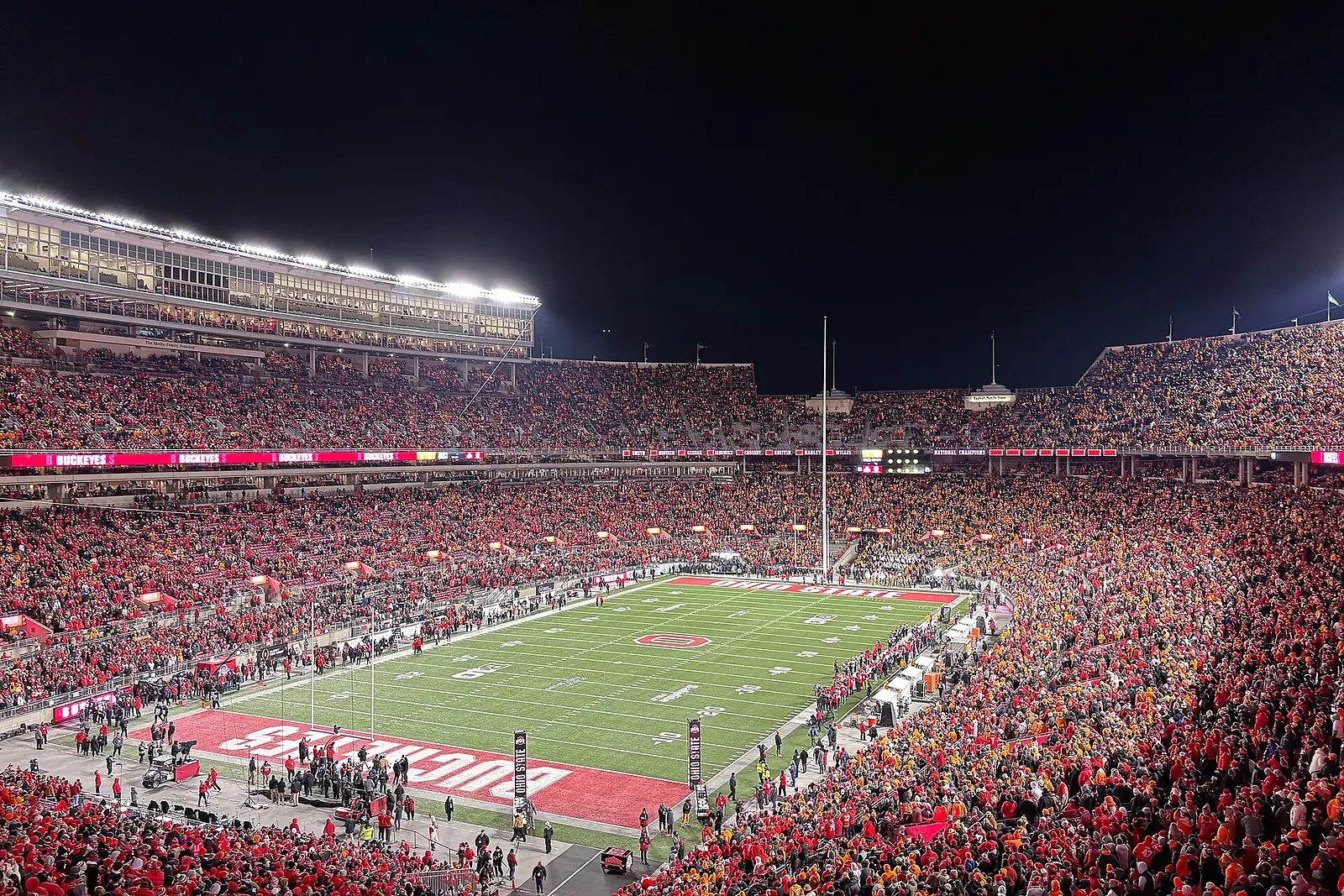
The first national ranking of a new season is usually treated like a ladder. No. 1 stands above No. 2, No. 2 above No. 3, and the conversation moves quickly toward which team was overrated or overlooked. The 2026 preseason coaches poll deserves a different reading. Its most useful signal is not the order. It is the shape of the vote.
Ohio State opens at No. 1 with 1,741 points and 38 first-place votes. That is a clear advantage. It is not unanimity. Oregon, Georgia, Texas, Notre Dame and defending national champion Indiana also received first-place votes, making this the first preseason coaches poll since 2008 with six teams represented at the top of at least one ballot, according to the American Football Coaches Association's official release.
That split matters because it separates two ideas that preseason rankings often blur together: the team most voters trust and the teams at least some voters believe can be the best in the country. Ohio State owns the first distinction. Six programs have evidence of the second.
The points reveal more than the ranking
The US LBM Coaches Poll uses a 25-to-1 scoring system: a first-place vote is worth 25 points, second is worth 24, and so on. The poll's published methodology makes it possible to translate the totals into a rough average ballot position across the 72 voters.
Ohio State's 1,741 points equal 24.18 points per ballot, roughly the scoring value of an average placement just under No. 2. Oregon's 1,637 points work out to 22.74 per ballot, or approximately No. 3.3. Georgia sits near No. 3.9, Texas near No. 4.6, Notre Dame near No. 4.8 and Indiana near No. 4.9.
Those calculations are not power ratings; they do not adjust for schedule, returning production or roster strength. They do show how coaches grouped the contenders. Ohio State occupies its own tier. Oregon is a clear second. Georgia, Texas, Notre Dame and Indiana are compressed into a band separated by only 69 total points—from 1,591 to 1,522—across 72 ballots.
The smallest gap is the most revealing. Notre Dame is fifth with 1,524 points. Indiana is sixth with 1,522. Two points separate them, even though Indiana received 14 first-place votes to Notre Dame's five. That means Indiana inspired more top-end conviction while also appearing lower on enough ballots to offset it. Voters agree less about the defending champion than the No. 6 label suggests.
Indiana is the poll's volatility team
Indiana's position is a compact summary of the central 2026 question: how much of a championship season belongs to a repeatable program structure, and how much belonged to personnel that has moved on?
The Hoosiers finished 16-0 and won the national championship, but Reuters' account of the poll notes that Josh Hoover replaces Heisman Trophy winner and top NFL draft pick Fernando Mendoza at quarterback. A voter who trusts Indiana's staff, infrastructure and roster development can reasonably rank the Hoosiers first. A voter who assigns a larger penalty to quarterback transition can place them outside the top five. Both views are visible in the same point total.
That makes Indiana more useful as a preseason case study than as a debate over whether sixth is respectful. The Hoosiers carry championship-level proof and one of the sport's largest role changes. Their weekly performance will tell us how much efficiency can survive a change at the game's highest-leverage position.
Ohio State has an early chance to validate the favorite label
The Buckeyes' advantage is not simply brand weight. Thirty-eight of 72 first-place votes represent a majority, and the point total leaves Ohio State 104 points ahead of Oregon. But the schedule creates an unusually fast test of that confidence.
Ohio State opens against Ball State on September 5, then travels to Texas on September 12. The official Ohio State schedule also includes a trip to Indiana on October 17 and a home game against Oregon on November 7. In other words, the preseason favorite is scheduled to face three of the other five first-place-vote teams before the postseason.
That is valuable for evaluation. Poll arguments normally linger because the leading teams do not meet. Ohio State's schedule creates direct comparison points: at Texas, at Indiana and against Oregon. If the Buckeyes hold the top spot, they will have multiple opportunities to earn it against the exact programs represented in the dissenting first-place votes.
The sequencing matters too. Texas arrives in Week 2, before either team has accumulated much public evidence. Indiana comes after a midseason stretch that includes road games at Iowa and a home date with Maryland. Oregon arrives in November, when injuries, depth and development should matter more than preseason projection.
Conference depth is not the same as title probability
The SEC placed nine teams in the Top 25 and the Big Ten placed eight. Together, the two leagues account for 68 percent of the poll. That is a depth signal, but it should not be mistaken for proof that their title odds are distributed evenly.
The first-place vote is more concentrated. The Big Ten's Ohio State, Oregon and Indiana combined for 58 of 72 first-place votes. Georgia and Texas combined for nine from the SEC. Notre Dame received five. The same poll therefore says two things at once: the SEC has the largest ranked population, while the Big Ten has the strongest concentration of perceived national champions.
That distinction will become important once conference play begins. A league can produce many ranked teams because its middle is strong. A different league can produce fewer ranked teams but more serious title candidates at the top. Counting logos in the Top 25 cannot answer which structure is more dangerous in a playoff.
The Big 12 illustrates the point from the other direction. Texas Tech is its highest-ranked team at No. 12, followed by BYU at No. 15, Utah at No. 21 and Houston at No. 24. None received a first-place vote, but four ranked teams give the conference multiple paths to build playoff résumés. The absence of a top-10 team is a preseason ceiling judgment, not a forecast that the league will lack consequential games.
What should move the poll first
The top six should not be evaluated by identical standards. Ohio State must show that its returning structure can support the consensus favorite role. Oregon must close a modest but meaningful point gap. Georgia and Texas begin close enough that one high-quality win could reverse their order. Notre Dame and Indiana are effectively tied, despite very different vote distributions.
The most informative early result may be Louisville against Ole Miss on September 6, followed by Ohio State at Texas six days later. Ole Miss begins No. 10 and Louisville is unranked but carries proven star power. That game will test the poll's boundary. Ohio State-Texas will test its top.
Preseason rankings are most valuable when treated as a baseline rather than a verdict. StatTake's working model for 2026 should track three forms of movement separately: result quality, underlying efficiency and expectation change. A team can rise in the poll because teams above it lose. That is not the same as producing stronger evidence. Conversely, a narrow road loss against an elite opponent can improve what we know about a team even while its ranking falls.
The StatTake conclusion
Ohio State deserves to begin No. 1 because the Buckeyes lead both components of the vote: first-place support and broad ballot strength. The larger conclusion, however, is that 2026 begins without a single uncontested model of a champion.
Oregon offers continuity and a clear No. 2 profile. Georgia and Texas sit within one tight contender band. Notre Dame has steady cross-ballot respect. Indiana has the widest gap between championship conviction and placement uncertainty. Six teams received first-place votes because voters are pricing different strengths—and different risks.
That is not poll confusion. It is useful information. The 2026 title race starts with a favorite, but it does not start with a monopoly.
What a team has accomplished, with explicit credit for opponent, location and quality wins.
POWERPENDINGV1.0-provisionalOpponent-adjusted team quality designed to describe how strong a team is right now.
FRAUDPENDINGV1.0-provisionalMeasures how far public results and ranking have outrun repeatable underlying performance.
WHAT’S YOUR TAKE?
Keep it about the game.
YOUR TAKE BELONGS IN THE CONVERSATION.
Create a free StatTake account to comment beneath full articles. Sign in with a private code sent to your email—no extra password.
- Comment beneath every full article
- Choose one public username
- Keep your email private
Loading comments…